Seaway Mural Trail

With the success of murals along the Erie Canal, murals have been also been painted along the Lake Ontario Seaway Trail.  We are doing our best to bring the wonderful history along the Seaway Trail alive.  You will find murals along the war of 1812, Native Americans and shipping on Lake Ontario. Mural Mania has murals from Ontario, N.Y. to Wolcott, N.Y. 

Ontario, N.Y.

Ontario Fire Company

Artwork by Wayne Central High School students in 2010. Located on the east side of the Ontario fire hall building which is on the west side of the street. Dedicated to All Ontario Firefighter Past & Present.  This mural portrays the 1881 hand pumper used by the Ontario Fire Company.

6160 Walter Cone Dr, Ontario, NY 1451

Sodus

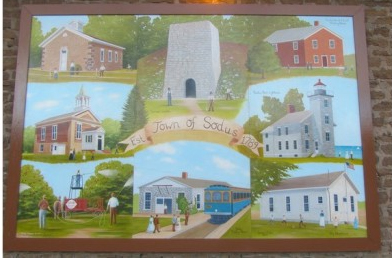
TOWN OF SODUS MURAL

This mural consists of 8 images representing representing the five hamlets and two villages contained within the Township. The area contains the hamlets:  Sodus Center, Alton, South Sodus, Wallington and Joy. The Villages are Sodus and Sodus Point. It also contains an orchard farming scene that pays tribute to our rural agricultural heritage.

Artwork by James Zeger   2015

Located at 31 State St., Sodus NY 14551

It is on the south side of State Street on the  wall of Laundry Junction.

Sodus Point

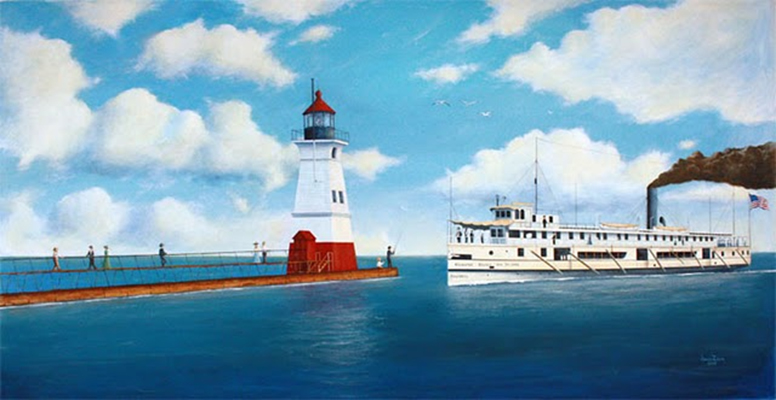
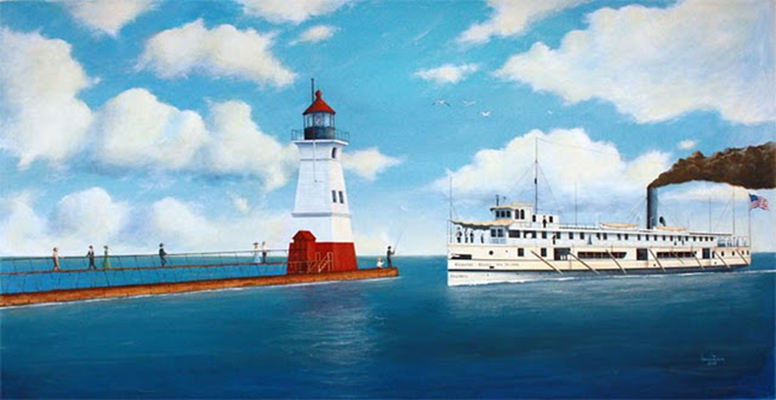
Sodus Point Pier

Sodus Point Pier 1890.  Artist James Zeger, this mural is in Jack’s in Sodus Point.

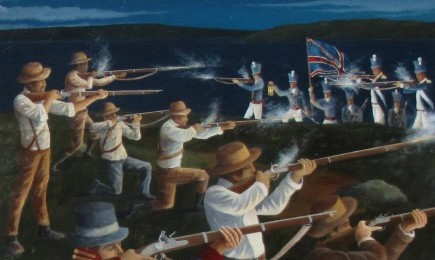
Battle of Sodus Point

The Battle of Sodus Point   This scene depicts the Battle of Troupville, now called Sodus Point, that occurred on the crest of a hill (now the intersection of John and Bay Streets) on the evening of June 19th,1813 during the War of 1812. A group of approximately 50 patriots (a combination of poorly trained militia and local volunteers with no military training) fired into the lines of advancing British marines as they ascended the hill from the western shoreline. Although greatly outnumbered and fighting some of the best trained and battle hardened soldiers in the world, these brave Americans had the courage of their convictions to defend our village from the British incursion. Unaware of either’s fighting strength and numbers, both British and American forces retreated; Britons to their ships and Americans to the heavy underbrush. The next day after a barrage from the cannons on their ships, the enemy landed once more. The British seized some stores in the warehouses (most provisions had been hidden in a nearby ravine the previous night) and burned most buildings in the village. Only one building, a tavern known as the “Mansion House”, survived the battle. This building was spared due the repeated efforts of commanding British naval officers who used the tavern to place fatally wounded American, Asher Warner. He died later that day. Another American wounded during the battle was Charles Terry who died from complications of his wounds a few weeks later. This mural is dedicated to the bravery of those early patriots who defended this village and, it is hoped, whose courage may serve to inspire future generations.

Artwork by James Zeger  June 2011

Located at:

8364 Bay Street, Sodus Point New York 14555

South side of Street on the west side of the firehall wall.

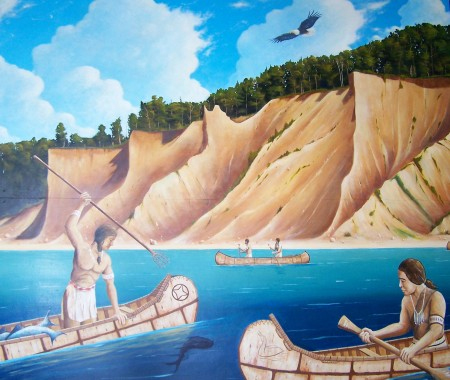
Native American Mural "Silver Waters"

This scene depicts Native Americans in the 1450s spear fishing near Chimney Bluffs. The word “Sodus” is said by most to be derived from the Indian word “Assodorus,” meaning “silvery water.” Two Iroquois Nation tribes (Cayuga and Seneca) used the Sodus Bay area for their summer home due to the abundance of fish and wild game. The Native Americans mostly used  Elm bark canoes (depicted in the background) which were locally made, very large, somewhat crude and disposable. They also traded with more northern tribes for the light weight, smaller and beautifully decorated Birch bark canoes depicted in the foreground. The bald eagle, (and their feathers) that is pictured in the mural, are highly revered and considered sacred within American Indian traditions, culture and religion. The bald eagle lives in the Sodus Bay area. The Native Americans vacated the Sodus Point area prior to it being settled by early American settlers in 1794.

Artwork by James Zeger   September 2010

Located at:

8364 Bay Street, Sodus Point New York 14555

South side of Street on the west side of the wall.

Underground Railroad Sodus Point

Located at:

8364 Bay Street, Sodus Point New York 14555

South side of Street on the East side of the firehall wall

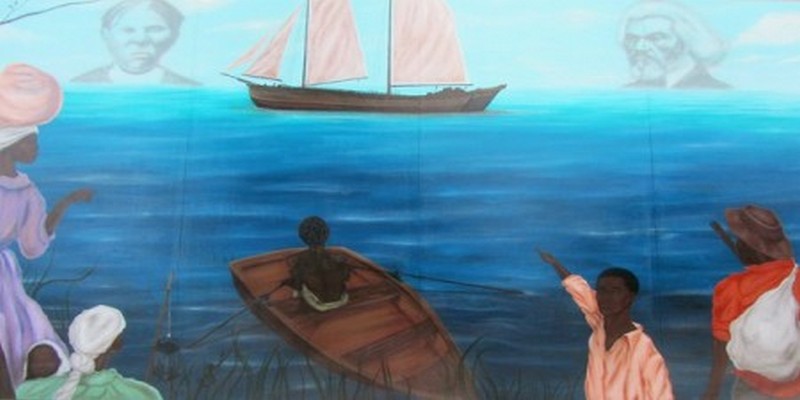
Underground Railroad in Sodus Point

This mural depicts a scene of the Underground Railroad. From stories passed down there were several safe houses in this area that were used to harbor “Freedom Seekers”. These included the old Cohn Farm and the old Sodus Fruit Farm and what is now Maxwell Creek B & B and Silver Waters B & B. Sometimes a schooner, out of the old Sodus Point ore dock, would pick up  slaves on its way to Canada.

Captain Garlock Photo (Copy)

Captain George Garlock ( 1832 – 1906 ) ran a freight schooner (sail only ) out of Sodus Point, NY named “Free Trader“ in the mid-1800’s. It was a two masted, one deck, 46 ton, squared sterned, carved head schooner with a crew of 4. He would take a load of lumber or ore from Sodus Point to go across to Canada. The schooner would leave anytime day or night depending on the weather. He would sometimes be going on Lake Ontario west and then north toward Canada to Brighton, Ontario (a small town pretty much straight across the lake from Rochester). If he saw a small rowboat off shore with people on it, he would stop and pick them up.

These fugitive slaves would come from the Cohn Farm and Old Sodus Fruit Farm ( Old Swales Farm ) and gather at a bluff overlooking Lake Ontario now known as “Freedom Hill”. If daytime they would see the schooner coming and at night time they used a lantern to get its attention. They would then go out in a small boat. These African-American people would then be “stowed away” on board until reaching Canada. Captain Garlock would then return with a load of grain to one of the local gristmills, or whatever he was bringing back from Canada.

Also pictured in the mural are the images of  Frederick Douglass (Rochester, NY) and Harriet Tubman (Auburn, NY) who were well known area African-American abolitionists.

Austin StewardAustin Steward was a slave who spent a year in Sodus Point and later would become a free man and well known author and abolitionist. In his book entitled  “Twenty-Two Years A Slave and Forty Years a Freeman”, he devotes a chapter about his experiences in Sodus Point. He wrote this about the Underground Railroad: “ Is not the necessity of an “under ground railroad,” a disgrace to the laws of any country? Certainly it is; yet I thank God, that it does afford a means of escape to many, and I pray that the blessings of Heaven may ever rest upon those who willingly superintend its interests”.

To read more about the Underground Railroad in Sodus Point and Austin Steward  visit www.historicsoduspoint.com

Artwork by Luis Zarate   June 2012

This Underground Railroad Mural is painted on the east side of the Sodus Point Fire Hall.  

Sodus Point Coal Trestle 2016

The Sodus Point Coal Trestle mural was painted by Erica Sweason during the the 2016 Global Mural Conference in Fairport, N.Y.. This mural features the Sodus Point Coal Trestle, which was used to ship coal to Canada from the coal fields Pennsylvania.  The coal was shipped on the Southern Railroad.  There is also a mural in Newark showing this same railroad. 

Williamson, N.Y.

Williamson, N.Y.

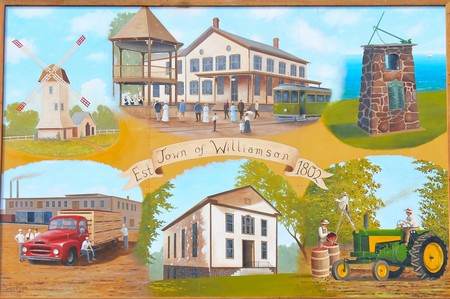
Memories of Williamson Mural

Commissioned by the Williamson Chamber of Commerce

  • As a representative of Williamson’s Dutch heritage the Windmill Vacation Cabins in East Williamson had a replica of a working windmill as it’s center of attraction. Circa 1960’s.
  • Early 1900’s Main Street shows the two-story gazebo bandstand, Hotel Williamson and the trolley that ran from the City of Rochester to Sodus Bay via Ridge Road.
  • The Lake Captains of Pultneyville Memorial was erected in 1935 and lists twenty-seven lake Captains, their schooner’s name and the year they took command of the vessel.
  •  K.M. Davies Co., Inc., a local cold storage and controlled-atmosphere facility, was established in 1914 and is located on Lake Avenue. This scene shows growers waiting to unload their apples at the warehouse. Circa  1950s.
  •  Gates Hall located on Lake Road in Pultneyville was built in 1825 and is designated the second oldest theater in America by the Library of   Congress.
  •  Apple Harvesting – Agriculture, produce processing and storage are Williamson’s major industries. Wayne County, in which Williamson resides, is the number one apple producing county in New York State.

    4090 Ridge Road, Williamson, NY 14589

    On the east side wall of building on the South side of the street

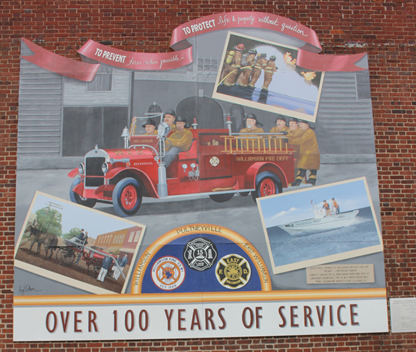
WILLIAMSON FIREMEN MURAL

Center Image – Members of Williamson Fire Co No. 1 circa 1925

Top Right – Firefighter Training

Lower Left – Firefighter & Horse Drawn Pumper Truck circa 1915

Lower Right – Pultneyville Fire Co. 15 Water Rescue WR-2

Mural designed and painted by Amy E. Colburn 2013

Located at:

4120 Ridge Road, Williamson, NY 14589

On the west side wall of building on the South side of the street

Sodus

Sodus Bandstand

The Sodus Bandstand mural was painted by Erica Sweason and can be found on the Sodus Fire Station.  Bandstand were on the second story so the sounds could be projected.

Wolcott History Mural
Being repainted in the Spring 0f 2023

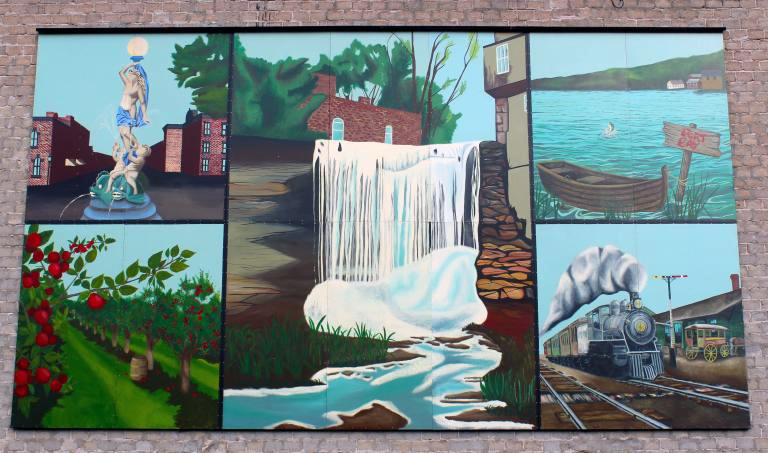
This 16′ x 32′ mural depicts several scenes of landmarks and history of Wolcott and the surrounding area:

The upper left image depicts one of the landmarks of Wolcott which is the statue of “Venus Rising From the Sea” at the four corners in downtown Wolcott. She is made of cast iron and is one of only eight in America. The statue arrived in September 1913. It was felt that with the installation of a public water system in the village, there should be some kind of public drinking fountain “for both man and beast” at the site of the old town pump and four corners. At one time there was a natural spring that came up out of the ground and was used to water the horses. The money to buy this statue was raised a few cents at a time and cost about $875.00.She has worn several different colors and at one time was painted a bronze color. Many objections were raised when she received the natural colors she now sports.

The center image depicts the Wolcott Falls. This 50 foot falls is located in the Wolcott Falls Park. Originally called “Ganadasqua” (Leaping waters above the lake) by Native Americans, it was the site of Melvin’s Mills which was established in 1809.

The upper right image depicts a scene from Port Bay. Port Bay is a beautiful Lake Ontario bay north of Wolcott that is popular for fishing and boating and comprises .9 square mile of water.

The lower left image depicts a scene from one of many apple orchards surrounding Wolcott. Farms such as Fowler Farms, Cahoon Farms and Van Fleet Orchards comprise hundreds of acres and make apples this area’s number one crop.

The lower right image depicts the Wolcott train depot. The first train came to Wolcott in 1872. The original depot still stands and it is the goal of The Wolcott Historical Society to someday use it for a museum.
The New York Central Station at Wolcott, N.Y. is located on the former “Hojack” line, which skirted Lake Ontario to its eastern terminus at Pulaski, N.Y. A lot of the Hojack has been abandoned, but some section are still in use by the Ontario & Midland Railroad.  The station still stands on W. Main St. In the village.  Its predecessor was the Rome, Watertown & Ogdensburg Railroad

The mural was dedicated on September 3, 2016.   The artists were Brenda Spencer from North Rose and Carly Trine from Wolcott.

Located at 12053 East Main Street Wolcott NY on the west side of the Wolcott Palace Theatre.

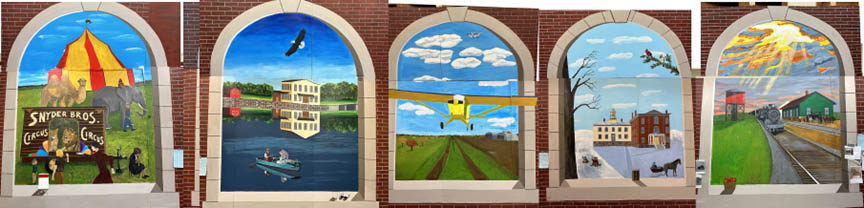
Red Creek Five Window of History
Coming in April of 2023